
What Czechia is talking about this week: Game on for casual sexism in politics
First a menopause jibe in Parliament. Now a foreign minister has taken aim at women's hockey. The backlash suggests Czechia isn't laughing along. But who is?
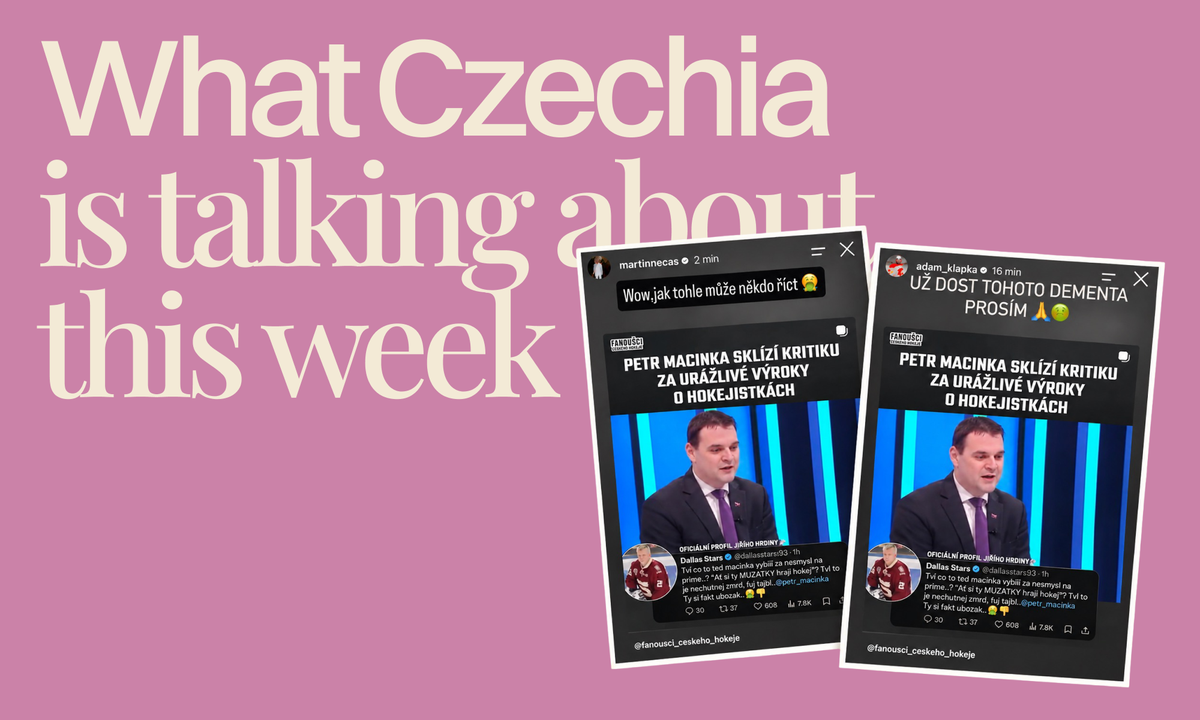
It took a Czech foreign minister's remarks about women's hockey to get some of the country's biggest male NHL stars talking about sexism.
“I rather regard ice hockey as a men's sport,” Peter Macinka told CNN Prima News on November 8, during a discussion about Russia's participation in the upcoming women's under-18 world championship in Ostrava.
“I do not please our great feminists when I say that they would have to live through the Czech championship without Russia's mužatky being part of it,” Macinka said in Czech. The word mužatky can mean “masculine women,” “mannish women,” or, simply, “men,” depending on the context.
What disturbed me wasn't simply that this came from the man responsible for representing Czechia abroad. It sounded like something my Czech father-in-law might say. In fact, when my daughter signed up for basketball, he said he was worried she might get hurt.
By Monday, Macinka had apologized. Not before his wife, he explained, had given him a talking-to and pointed out that if their daughter wanted to play hockey, he'd be driving her to practice. (Not sure that paints a particularly equal picture of their marriage.)
Quite a public-relations puck-up. The story blew up on social media and reached The Athletic, part of The New York Times, just as the ruling coalition faces massive public backlash over its moves to change Czechia's public-media funding model. A major protest is planned for Letná on Sunday.
Macinka knows how comments can travel.
At February's Munich Security Conference, he joined Hillary Clinton, Polish Foreign Minister Radosław Sikorski and two political scientists to discuss divisions within the West. Macinka defended Donald Trump's policies by criticizing the “gender revolution.”
“Which gender revolution?” Clinton interrupted. “Women having their rights?”
The exchange circulated through American conservative media, reaching Joe Rogan's podcast, where Macinka became the “Czechoslovakian guy.” (Joe Rogan's geography has left the chat.) The clip was also shared by Barron Trump on TikTok.
And it's not just the foreign minister who's landed in the penalty box of late.
On October 21, SPD MP Miroslav Ševčík shouted “menopauza” after STAN politician Michaela Šebelová requested a parliamentary break. He denied directing it at her and insisted menopause wasn't vulgar. She filed a complaint; disciplinary proceedings opened on November 10.
And some politicians are still laughing. SPD MP Marie Pošarová defended Ševčík's remark as a joke: “Pauzu, menopauzu.”
It might sound like a harmless dad joke (or father-in-law joke). But the wider climate isn't encouraging.
The 2026 Areto Global Hate Speech Index found its sexism measure across international sports social media was up 92 percent year-on-year.
Closer to home, Czech researchers examining nearly two million comments in 17 anti-establishment Facebook groups found that female politicians were disproportionately targeted by gender-based attacks, with disinformation and media amplification helping to trigger the hostility.
Czechia has made progress in criminalizing sexual violence, including adopting a consent-based definition of rape in 2025. KONSENT, the Czech organization celebrating ten years of work on consent and sexual violence prevention, is now asking supporters whether its next decade should include projects offering boys and young men an alternative to the misogynistic and manosphere content they encounter online.
This time, the men making the most noise about women's sport weren't the Facebook trolls or the armchair warriors. It was hockey stars many of them idolize.
And they weren't laughing. Colorado Avalanche forward Martin Nečas, Anaheim Ducks goalie Lukáš Dostál and New York Rangers prospect Jaroslav Chmelař took to Instagram to call out Macinka's comments.
Women's national team manager Tereza Sadilová had the last word, expressing pride in her players and vowing to fight for every girl pursuing her hockey dreams.

Comments ()